Tuesday, August 21, 2012

On the Separation of Kitchen and State

In the mid-1990s, I was the assistant to the president and publisher of an influential, award-winning magazine and website based in San Francisco. It was a demanding, high-stress job; I often had to come in on the weekends and even sprained my ankle in the line of duty (i.e., while sprinting across the street with lunch for my boss). On the plus side, the company was full of smart, inspired, and inspiring people in a fun environment that encouraged community and creativity. (Some might describe it as “cultish,” but that’s another story.)

There were lots of perks, too. Though in-house happy hours, massages, and game rooms were soon to become de rigueur at workplaces all over the Bay Area, such amenities felt special then. I particularly appreciated having our own professional chef on staff. Not only did “Phil” and his sous chef, “Ivan,” make delicious organic meals for us every day, but my interest in cooking had been growing steadily over the years, and having such close access to these experts to talk with about food was pretty neat.

At one point, my boss (I’ll call her “Joan”) was out of the office for an extended period, a couple weeks or so. While I was holding down the fort in her absence, I managed to find a few pockets of time when I didn’t have any pressing matters to attend to. This was in the early days of Web 1.0—not just pre-YouTube or even pre-Friendster but pre-Google—so I had to seek out other ways to occupy myself.

I gladly found diversion in the kitchen: For a few minutes here and there, I volunteered to prep vegetables and picked up some rudimentary tips along the way. For instance, I learned the correct way to position my left hand while chopping with my right to keep from accidentally julienning my fingers. Also, finally giving in to my incessant requests, Phil relinquished the recipe for his chilled black bean soup. Accented with fresh lime and a shot of Tabasco, the cold puree makes for a perfect summer lunch. It takes up to 2 days to prepare (including chilling overnight) but requires only a handful of ingredients, is totally vegan*, and contains absolutely no fat*. It quickly became one of my favorites.

I forget how it came up: Either I happened to mention to “Steve,” my counterpart in the editor’s office, that I’d been spending some of my down time with Phil and Ivan, or he might have been walking by and seen me there. What I do remember is that he pulled me aside and said in a very serious, almost menacing, tone, “JOAN'S ASSISTANT DOES NOT WORK IN THE KITCHEN.” I’d always liked Steve, and in all fairness to him, maybe in his own weird, elitist way he was just looking out for my professional interests, or trying to protect those of my boss (who was sort of his boss, too, after all). But seriously, what the shit? In any case, I gave up my casual culinary apprenticeship when Joan returned to the office, and somehow we both lived through the experience without scandal. PHEW.

It's been unbearably hot around here the past couple of weeks, so naturally this chilled black bean soup has been one of my go-to meals. I’m not at liberty to share Phil’s (far superior) recipe, but I’ve adapted it into a simplified, scaled-down version with canned beans that takes less time to make. That said, use only organic products if available because—as Phil advised—in such a simple soup, the best ingredients shine through.
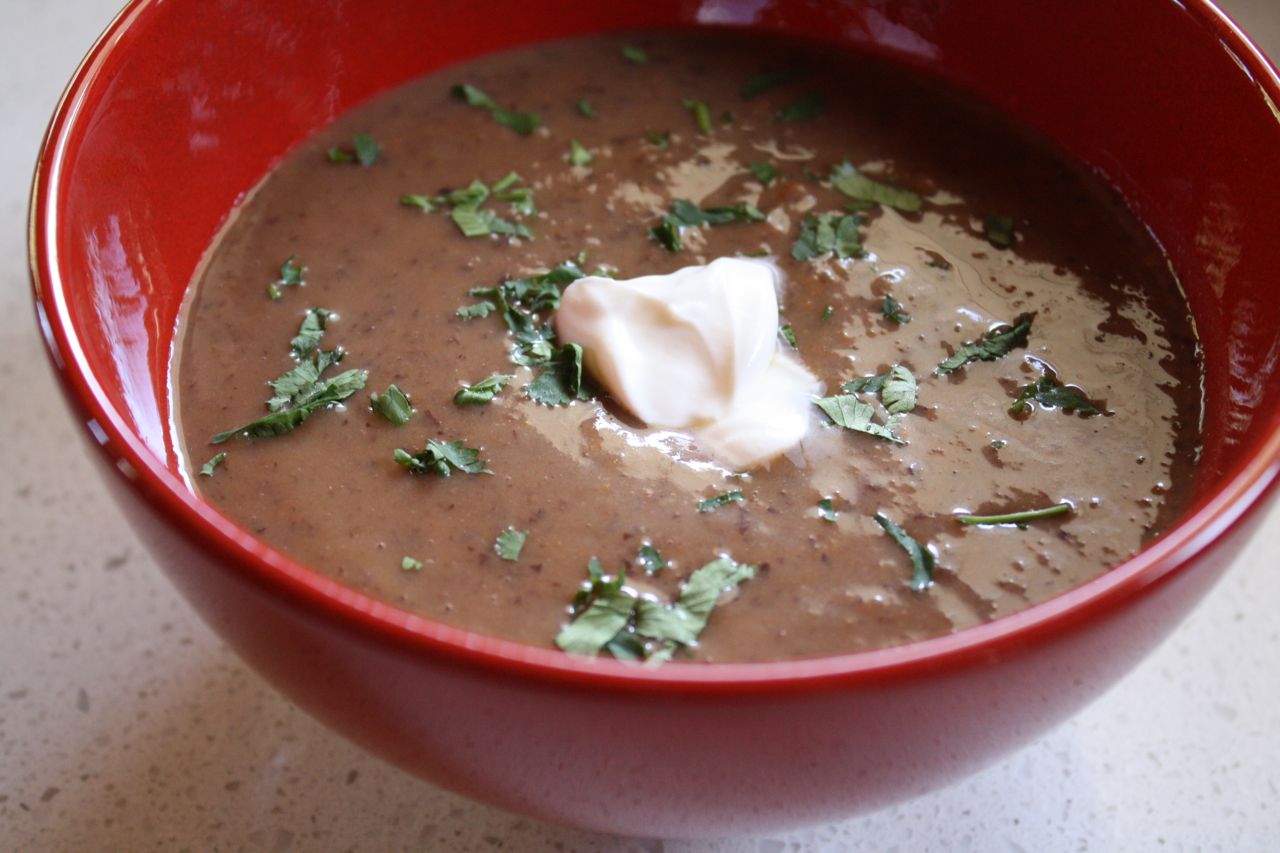


Chilled Black Bean Soup

1 small carrot, peeled and chopped
1 celery stalk, chopped
Half a medium onion, chopped
1-2 garlic cloves, peeled and chopped
¼ cup water
2 15-oz cans black beans, drained and rinsed
1 quart vegetable broth
1 bay leaf
1 tsp salt
Tabasco sauce
Juice of 1-2 limes
A few sprigs fresh cilantro, finely chopped
*Sour cream (optional)

In a sturdy pot over medium heat, sweat the carrot, celery, onion, and garlic in the water until onion is translucent. Add beans, broth, bay leaf, salt, and a few dashes of Tabasco, and gently cook for about an hour. Remove from heat, discard bay leaf, and let cool. Chill in the refrigerator for at least 4 hours (or overnight if time allows). When soup is cold, puree it in batches in a blender. Add lime juice to taste and, if needed, more salt and Tabasco to taste. Return soup to refrigerator until ready to serve. Just before serving, ladle into bowls and garnish with cilantro and an optional dollop of sour cream.

Thursday, January 12, 2012

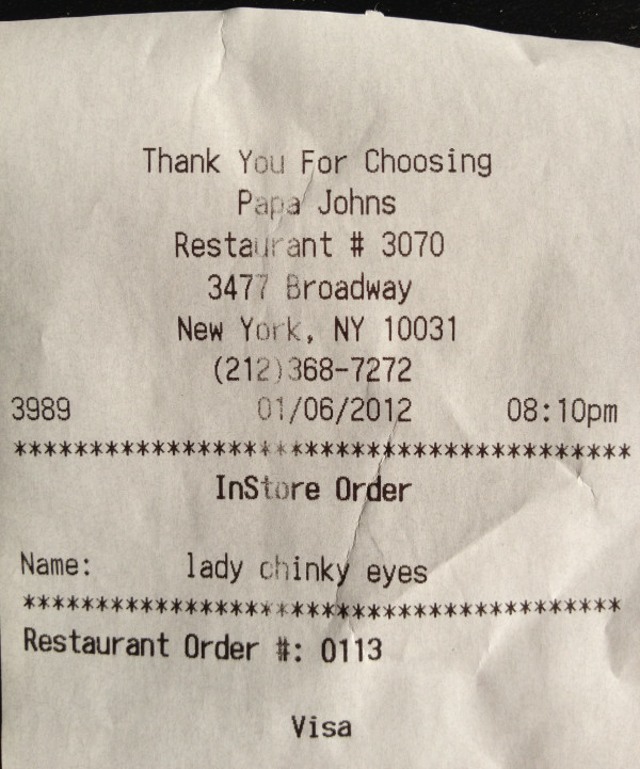
Some Thoughts on "Lady Chinky Eyes"


“Lady chinky eyes” blew up last weekend, and it might be old news at this point, but I wanted to take some time to reflect on it. In case you don’t know what I’m talking about, an employee of a Papa Johns pizza joint in Manhattan was fired after she’d used the offensive phrase on a receipt to describe a customer and a picture of it “went viral” on Twitter. It happened just a month after another fast-food restaurant, Chick-fil-A, fired a cashier for naming two Asian college students “Ching” and “Chong” on their receipts.

Honestly, I’m not sure I’d have given the matter more than an indignant retweet, but a friend whose intelligence I respect expressed sympathy for the boss’s point of view, which was that the employee could learn more from a conversation about racial sensitivity than from being fired. So I read and reread the boss's response to the incident in Saturday’s article on Gothamist.

First of all, I buy that the boss is a thoughtful mentor type. In fact, I did a little research and learned that Ronald Johnson, the Papa Johns operating partner quoted in the piece, is a widely admired finance whiz who reportedly grew up poor in New York City and whose success story has been featured by Crain’s New York Business and Entrepreneur, among others. To his credit, he expressed disappointment and outrage at the incident right off the bat. So let me take up his other remarks:

He said the female cashier was a “16-year-old urban youth who listens to this nonsense all day on TV and radio”—he said the incident reflected a larger disconnect in modern youth culture. . . . “When I googled the phrase, all these songs came up.”

I can’t help but wonder why he had to Google it. Was he unfamiliar with the expression? Anyway, to appreciate what he meant, I also Googled The Phrase. Of course, most of what comes up now are blog posts and news articles about the incident. But I did manage to find a whopping four examples of songs containing The Phrase in my admittedly cursory search. The first was an insipid ditty by a husband-and-wife Vietnamese pop duo, and I think it’s safe to say that particular tune hasn’t permeated the consciousness of urban youth in New York. The other three were by hip-hop artists, only one of whom I’d ever even heard of: Nicki Minaj. Her song “Cuchi Shop,” from almost four years ago, depicts a brothel madam who asks what kind of prostitute a client is looking for: “What you need, thick thighs and some chinky eyes?” Now there’s a true reflection of modern youth culture. Any teenager who’s ever perused a whorehouse menu could tell you that, or something.

“These kids bring their baggage into the store with them. I dont know if I should fire her." Johnson said it's normal practice for cashiers to identify customers with phrases like "lady with blue shirt" or "man with Yankees cap."

Obviously he understands that The Phrase isn’t comparable to the color of a shirt or a baseball team’s hat; what he meant is that this misguided teen is most likely unaware of its derogatory nature and was using it simply as a descriptive device. So where would he draw the line? There are equally or, some might argue, even more racially offensive terms one could substitute for The Phrase, which I won’t bother to articulate. But let’s take inflammatory language out of it altogether: What about identifying a customer as “fat guy” or “big tits”? (Chow has a summary of similar instances of offensive language used on receipts, racial and otherwise, here). Obviously, there need to be policies in place, regardless of whether the description is an intentional insult or merely an unfortunate choice of words.

"I bet I'll talk to her and she wont know why this is offensive. She needs to know, and she will know. If I fire her, two years from now, she won't even remember why she got fired. If I sit her down and talk to her, I can help her. You still need a certain decorum and level of professionalism [at minimum wage jobs], and that may help her more in the long run."

This is the real heart of the argument and, I suspect, the basis for why my friend found the boss a sympathetic figure: He’s like Edward James Olmos in Stand and Deliver, and the cashier is Lou Diamond Phillips. She just needs someone who believes in her! And that is a nice thought. So, okay then—with a little patience and a little guidance, she could win Employee of the Month someday. "A negative times a negative equals a positive." (That's a line from the movie.) After all, despite the public outcry, the “victim” in this case wasn’t substantively wronged. She wasn’t refused service. She wasn’t charged an arbitrary fee. She wasn’t made to eat her mediocre pizza in a separate, but equal, section of the restaurant. Assuming this was a truly isolated event and doesn’t reflect a pattern of hostility, it would be alarmist at best to claim that she suffered real, live, racial discrimination.

But regardless of the boss’s good intent, to allow this incident to slide, even if only to give the young employee a chance for sensitivity to be trained into her, would be tantamount to racism—an institutional condoning of the use of a racial slur by a company representative. Firing the cashier and offering a corporate apology was the appropriate response and the minimum outcome that could be tolerated by a conscientious consumer. And by the way, he’s dead wrong about the alternative; I’m pretty sure she is going to remember why she got fired. And so will all her coworkers and everyone else who’s heard about it.

Here’s the thing: An action as crude as typing a disparaging remark on a fast-food receipt is a relatively minor transgression. It’s appalling, but at least such behavior can be identified, disciplined, rooted out. Personally, what I’m far more disturbed by, what’s much more insidious, are the subtler forms of maltreatment that occur every day in “real” restaurants, including ones that are respected for their supposedly superior quality and service. Being made to wait an hour after a scheduled reservation while parties who arrived later are seated; getting stuck by the bathroom, next to a swinging door, or way in the back in a dark spot where you can’t even see your meal; being left to sit without food or drink while others are seated, served, and settled up—these are some of the indignities I’ve endured, however seemingly slight. I won’t name names, but I’m talking about some well-regarded places. Zagat-rated places.

First World problems? Sure. But another reason I’ve been hesitant to vocalize my suspicions is, well, I can’t possibly be being treated differently, can I. This is the 21st century, in a cosmopolitan city where people of Asian descent make up more than 11% of the population. Double digits! I accept that not every experience can be optimal. We can’t all be seated at the best table; hosts and servers alike get overwhelmed; some patrons might have a special relationship with the establishment that affords them special attention.

And even if I receive service that’s doesn’t seem quite as good as it could or should be, race isn’t necessarily the issue. Maybe I’m not dressed well enough, or maybe I’m simply not assertive enough. Or there’s always the chance that these things happen inadvertently, randomly, purely incidentally. That’s what I keep telling myself anyway. And keep telling myself. Because the truth is it happens a lot.

Wednesday, September 7, 2011

The Camp Kitchen


One of my absolute favorite pastimes as a kid was what I called "Lost in the Woods." The sparse patch of trees behind our suburban Maryland house was, in my imagination, the deep wilderness, where my friends and I built shoddy shelters out of branches and subsisted on the nectar of wild honeysuckles that grew back there or, more often, on the leftover Halloween candy we’d conveniently stuffed into our pockets beforehand.

Though I didn’t turn into a backpacking nut—far from it—I’ve loved the camping trips I’ve taken since then, the most recent being a solo cross-country excursion almost exactly a decade ago. Even so, my campsite cooking experience barely extends past boiling water for coffee in the morning. And assuming Mr. Comma would never be up for roughing it, I donated all my camp gear when we moved to our new house last year.

Of course, now that I’ve been proven wrong and we’re about to go on a (car) camping adventure, we’re starting from square one. This time, I’m determined to put our new camp stove to real use, so I’ve assembled a makeshift mobile kitchen comprising what I think are the bare essentials:

Pot, skillet, and lid that fits both
Knife set and cutting board
Wooden spoon, spatula, tongs
Mixing bowl
Kettle
French press
Tableware, utensils
Can opener
Corkscrew
Dish towel

This all fits into a record crate–sized bin, with room to spare. Am I missing anything?

Monday, August 29, 2011

The Bundaberg Mystery

At 432 views and counting, this snapshot of a cup of soup and a bottle of Bundaberg ginger beer taken at Little Flower Candy Company in Pasadena is my current most-viewed food photo on Flickr—followed closely by my other pictures that feature this refreshing, nonalcoholic beverage from Australia. But I'm unable to identify where all the traffic's coming from. According to Flickr, the referrer(s) to this photo is "unknown." I've even made a direct appeal to viewers to clue me in, but no dice. Is there a secret cult of Bundaberg enthusiasts out there who spend their free time looking at bottle porn and won't admit it?

Monday, December 13, 2010

What's the Buzz? HenriettaHaus Coffee Roasters


HenriettaHaus display at the Oakland County Farmers Market, Michigan

Some people’s idea of a fresh cup of coffee is being first in line at Starbucks. How about roasting the coffee beans yourself in your own home? That’s what Amy Duncan started doing several years ago using an ordinary stovetop popcorn popper.


One mean coffee bean roasting machine

Today, this 2-kg Ambex commercial roaster is a more sophisticated means to produce the beans for HenriettaHaus Coffee Roasters, Amy's brand-new Wyandotte, Michigan-based business. But quality is still the top priority, and each small batch gets all the care and personal attention as those first roasts on her kitchen stove. Food Comma got to see the process up close in a private demonstration of the Henriettahaus Coffee Roasters works during a recent visit to Mr. Comma's home state.


(Click to enlarge)

1. The Ambex is fired up. 2. A small batch of raw, organic coffee beans is carefully measured out. 3. Once the roaster reaches the proper temperature, the beans are fed in. 4. Periodically through the roasting process, Amy checks for color and aroma. 5. When ready, the batch is cooled and given a final inspection for any beans that have not achieved a perfect roast. 6. The freshly roasted coffee beans are ready to be weighed and packaged.


Each bag is hand stamped and labeled with the coffee's country of origin and date of roast

HenriettaHaus is just beginning to hit the market in the Detroit area, where it can be purchased at the Burton Theater in Cass Corridor, at the Oakland County Farmers Market in Waterford Township, and via direct, personal delivery around Detroit, Ann Arbor, and environs. But even outside Michigan, this handcrafted, small-batch coffee can be shipped right to your door, whole beans or ground. Makes an excellent stocking stuffer! Send an email to orders@henriettahauscoffee.com for all the details.


Read Food Comma's previous interview with Amy about her inspiration for HenriettaHaus and how she got started.

Thursday, December 9, 2010

Bauer Pottery Holiday Sale

Fave local blog/daily read The Eastsider has a nice post about northeast LA's historic potteries, focusing on Bauer Pottery Company, established in the 1880s in Kentucky and relocated to Los Angeles in the early 1900s. Bauer's iconic Ring-Ware line, introduced in 1932, flourished during the arts and crafts movement with its vivid colors and often-imitated design.


Bauer and Russel Wright ceramics

Though Bauer's original operation shut down in the 1960s, the trademark was revived in 1998 with the aim of reproducing the pottery's classic wares. Today, the Bauer Pottery Company's showroom resides off of San Fernando Road at the edge of Forest Lawn Memorial Park, coincidentally where founder J.A. Bauer is buried, just a few miles from the historic studio.

And it just so happens that Bauer is having a holiday sale on seconds and clearance items. Food Comma visited last weekend and scored some great deals on gifts and even a little present or two for myself.


Bauer butter dish

A couple years ago I'd been close to getting the vintage version of this butter dish for $80, but just couldn't justify the expense (which Mr. Comma was going to spring for as a birthday present). Good thing I held out: we scored this one at the sale—same great looks, same color—for about $30. What will Mr. Comma buy me with the money he saved?

Incidentally, Bauer also produces the American Modern line of ceramics from Russel Wright, subject of my last post.

Bauer Pottery Holiday Sale, Dec. 11-12
3051 Rosslyn Street
Los Angeles, CA 90065
9am to 5pm
(818) 500-0666


Monday, November 8, 2010

Love at First Wright


Probably my favorite thing in the kitchen right now: this Russel Wright sauce boat, found at the PCC flea market over the weekend. Its fusion of design, function, and craftsmanship makes it a perfect object. (Sorry about the title of the post, but terrible puns like that are why I get paid the big bucks.)

Friday, November 5, 2010

Warren Zevon's Favorite Burrito

Check out this excerpt from Wonderland, a 1977 Dutch documentary about the LA singer-songwriter scene featuring Warren Zevon, Jackson Browne, Bonnie Raitt, and Linda Ronstadt (then-girlfriend of governor-elect Jerry Brown, also governor at the time). In the clip, Zevon pays a visit to Echo Park’s own Burrito King, back when the neighborhood was considered, according to his own lyrics, “the outskirts of town.” Here, he also calls Burrito King’s cuisine “some of the finest Mexican American food in Southern California.” Perhaps that was true 3+ decades ago, but the last burrito I ate from there gave me a horrible stomachache. Maybe I just didn't order right; Zevon recommends the machaca burrito.


Remarkably, the corner of Sunset and Alvarado nowadays appears pretty similar to the way it did then, creepy American Apparel billboard notwithstanding. Burrito King continues to shares the strip mall with a liquor store and a cleaners, though names and precise locations may be different, and Pizza Buono still anchors the southwestern corner. Even Sunset Auto Spa seems to be just a more modern iteration of the business that stood there before. But it’s a bit sad to see, in the clip, the big old houses around the corner from the carwash, knowing that they’d be demolished and replaced by a bunch of ugly lofts.

Monday, November 1, 2010

Mystery Mushroom?


I guess this would fall under the "comma" part of Food Comma, being that I'm not entirely sure this thing is organic matter, let alone edible. I discovered this alien life (?) form as I was pulling weeds in the front yard. At first glance, I pegged it as a big mushroom, about 2 inches in diameter; on closer inspection, I noticed part of the purplish top layer appeared to be peeled off, revealing a gelatinous-looking core. A fallen bird egg? It seemed way too big, and anyway there are no nests nearby that I know of.


Digging the thing out with a stick, I felt a slight resistance that, say, some decaying rubber ball discarded in the dirt might lack. But then its tapered and somewhat pleated bottom end suggested a sort of balloon, and the way the thing feels both firm and squishy reminds me of, like, a silicone implant. Yeah: creepy. I showed it to Mr. Comma, who immediately remarked on its resemblance to a puffball, a mushroom-like fungus. I left it outside overnight and apparently none of the various Eagle Rock wildlife (squirrels, possums, raccoons, skunks, birds, cats, lost dogs) so much as took a sniff at it, as far as I could tell. I know the next step is to cut it open, but I'm a little scared . . .

Sunday, October 31, 2010

Happy Hallowe'en

Sorry, everyone. They beat you to this killer culinary costume.


Easy Cheese food truck, Halloween 2010

Wednesday, October 27, 2010

Chicken Breasts Stuffed with Pesto

Of the more than 2,200 meals I’ve photographed, this simple dinner I made a couple months ago—chicken breast stuffed with homemade pesto, with linguine and French green beans—is for some reason my most-viewed food picture of the past three years. I don’t have a recipe per se, but the basic preparation for two servings is as follows.


Preheat oven to 350.

Sprinkle salt and pepper on both sides of two boneless, skinless chicken breasts. Using a carving or other long slender knife, pierce the center of one end and make a lengthwise incision into each breast, forming a pocket, taking care not to cut all the way through. Stuff a big spoonful or two of pesto into each pocket (recipe follows, or use store-bought pesto).

In a heavy, ovenproof skillet over medium-high heat, swirl a tablespoon of extra virgin olive oil, then brown the chicken skin side (if there were skin) down for a few minutes. Turn the breasts over and place skillet in the oven. Bake until cooked through, about 15-20 minutes.

Meanwhile, boil the linguine the usual way, drain, and toss with a tablespoon of softened butter per serving. Sauté the green beans in a bit of olive oil and minced garlic. When the chicken is done, let it rest for a couple minutes, then slice each breast crosswise into four pieces. Serve over pasta and green beans, with a little extra pesto spooned on top and sprinkled with grated Parmegiano Reggiano.

To make pesto, whiz together in a food processor or blender the washed leaves from a big bunch of fresh basil (a few cups), ¼ cup grated Parmegiano Reggiano, a handful of toasted pine nuts, and a couple cloves of chopped garlic. While the machine is running, slowly pour in a good glug of extra virgin olive oil and blend until the mixture is smooth. Season to taste with salt and pepper.

Thursday, October 21, 2010

Eating the Eastern Sierras

Mr. Comma and I have been road tripping up the 395 to Mammoth Lakes annually for the past 6 years to celebrate my birthday in early October. It’s the perfect time of year to visit if you like crisp autumn weather, trees with shimmering yellow and orange leaves, and none of the crowds of summer or winter.


The Stove, in Mammoth's "old town" area

Even without the seasonal hordes, there’s almost always a bit of a wait for breakfast or lunch at the Stove, a Mammoth Lakes institution. Fortunately, tables at this cozy eatery tend to turn over fairly quickly, what with all the great outdoors waiting to be had. I think the Stove is the one place where we’ve eaten at some point every single year we’ve come to town. Hearty and homey, it’s pure mountain comfort food.


Many meals at the Stove (click to enlarge)


Convict Lake

Just a few miles south of Mammoth is stunning, crystal-clear Convict Lake, cut deep into the Sherwin Range at the foot of Mount Morrison. The Restaurant at Convict Lake has a reputation as one of the best (and most expensive) fine dining establishments in the area—we’d indulged in a decadent birthday dinner of beef Wellington and seared duck here a couple of years ago—but little did we know that the adjacent lounge serves casual pub grub that’s delicious and cheap. After a glorious afternoon boating on the lake, Mr. Comma and I tucked into a bowl of bartender/chef Tim’s chili for a mere $5. Homemade with pinto beans, chunks of tri-tip steak, tomato, and a blend of spices, and garnished with grated cheddar and crunchy slivers of fried onion, this simple and satisfying meal was one of our favorites of the trip. (Tim knows how to pour a drink, too.)


Tim's tri-tip chili at the Restaurant at Convict Lake's lounge


A good pour

No mountain food round-up would be complete without mention of the Whoa Nellie Deli. Perhaps most famous for being located inside a Mobil gas mart, near the eastern edge of Yosemite National Park, the modest kitchen dishes out gourmet fish tacos, lobster taquitos, wild buffalo meatloaf, and more, all with a view of Mono Lake. The prices are a bit higher than at your average walk-up counter (entrees run from $11.95 to $19.50), but the unique setting makes the Whoa Nellie Deli worth checking out.


The Whoa Nellie Deli at the Tioga Gas Mart (click to enlarge)

Finally, one of our essential stops on the way out is Pie in the Sky Café at the Rock Creek Lakes Resort, about 9 miles up an aspen-lined road snaking through the Inyo National Forest. Hikers, bikers, campers, fishers, and nature photographers all converge at a tiny, 6-stool counter tucked in the corner of the rustic resort’s general store to feast on a selection of half a dozen or so piping hot pies baked from scratch every morning. Come too early and some of the pies aren’t ready yet; come too late and they’re all gone. On our most recent visit, we savored a slice each of lemon cream and Mom’s apple, and a fellow customer let us sample a bite of her cheddar pear pie—an unlikely combination but one of the cafe’s most popular. We were lucky to catch Pie in the Sky open on its last day of business before closing for the season.


Pie in the Sky Café (click to enlarge)

I'm already looking forward to next year.

Thursday, September 23, 2010

Market Research: Seafood City


Since its original store opened in San Diego 20 years ago,
Seafood City has expanded to 20 locations throughout California as well as in Las Vegas and Seattle. It’s essentially an ethnic supermarket chain, touting the “at home" experience—that is, if you call the Philippines your homeland. And since Filipinos make up the highest proportion of all immigrants living in Eagle Rock, the neighborhood is a prime spot.


Kabalikat, roughly, is Tagalog for "partner"

Seafood City opened 4 years ago in the Westfield Shoppingtown Eagle Rock Plaza, aka the Ghetto Target Mall. Its placement inside the mall is itself noteworthy. Is it an Asian thing? The Koreatown Galleria also houses a supermarket, on the bottom floor, but if I’m recalling correctly, the Galleria Market doesn't open directly onto the main part of the shopping center. Come to think of it, the Target sells groceries too, making it a grocery store inside a big-box store inside a mall. Anyway, Seafood City’s location is very convenient if you also need to join the army, pick up a coaxial cable at Radio Shack, or purchase a burial plot from Forest Lawn—all possible within Eagle Rock Plaza.


Clockwise from top left: whole parrotfish and red snapper; dried fish; beef blood, commonly used in blood sausages and savory stews; Manila-style hotdogs.

Needless to say, the market’s main attraction is its seafood. Dozens of varieties of fresh seafood are displayed atop open, ice-filled trays—whole salmon, trout, anchovies, catfish, parrotfish, mullet, you name it, plus shrimp, clams, crabs, squid, and so on. You select and bag the fish yourself, which you can have cleaned and even fried while you wait, or you can choose from a selection of already cut fillets or steaks from the case. There’s also a wide range of frozen fish, dried fish, and fish snacks. But if fish isn't your thing, the store offers all the usual proteins, and some unusual ones, like pig snouts.

There's much more to Seafood City than seafood and random pig parts. The produce section is stocked with all kinds of fruits and vegetables both common and exotic, especially those used in Filipino and other Asian cooking. Pet peeve: They sell garlic only by the five-pack. Why?


Left side: chayote, duck eggs. Right side: banana blossoms, long beans, Chinese eggplant.

The popularity of Spam among Asians is fairly well known, but I was not aware of the sheer breadth of Spam alternatives out there.


It seems the preferred container for crackers is the plastic tub. Note FITA's resemblance to RITZ. Also, the Magic Flakes logo and packaging give it an unappetizing, laundry detergent-like quality.


What I got: a couple of catfish steaks, oxtail, coconut milk, fresh cilantro, an avocado, two lemons and a lime, a yellow onion, green beans, Chinese broccoli, scallions, bananas, guava juice, frozen shumai, and a six-pack of beer. Total, including the beer: $35.79.


Not pictured: three bananas

Incidentally, Red Horse is made by San Miguel, which I had always assumed was a Mexican brewery. In fact, it's Filipino!

Wednesday, September 1, 2010

Market Research: Super A Foods


Food Comma headquarters recently relocated to Eagle Rock, and as such, I’m on the hunt for a new local grocery store. Granted, the Vons is a mere three blocks away, but for various reasons, I’ve decided to try to check out as many of the markets in the neighborhood as possible. Consider this the first installment of a regular feature called Market Research.


Clockwise from top left: time to shop, the Asian aisle, groovy font, econo-size menudo

Super A Foods, which bills itself as a family-owned-and-operated full-service grocery store, is a regional chain with 13 locations in the greater LA metro area. The Eagle Rock outlet is a total throwback to the supermarkets of my youth, with its 1970s color palette (think brown, orange, avocado green), groovy fonts, and seagull and sailboat décor.

I like seeing how different stores cater to the local demographic. There doesn’t seem to be a huge demand for organic produce among Super A's patrons; on the other hand, you can find a good selection of Mexican cheese and crema.


I never saw cactus fruit at the Los Feliz Albertson’s.


Cactus fruit, Bosc pears, mangoes

Super A also offers bulk lard, if that’s what you're into.


I picked up just a few items for the rest of the week’s meals: a ribeye steak, some ground turkey, bacon, a bag of Mexican sandwich rolls, a grapefruit, a lime, a few roma tomatoes, romaine lettuce, watercress, and a frozen pizza and ramen noodles for the inevitable lazy nights when I don’t feel like cooking. The damage came to $31.84.


Of course, that excludes the bottle of Maker’s Mark for $18.99, which I spotted just as I was leaving. And for a deal like that, I’ll definitely go back to Super A.

Wednesday, August 25, 2010

Feasting at the Fair

Carnival rides. Pig races. Weird Al Yankovic. These were all highlights of Food Comma's trip to the OC Super Fair this summer, but we all know the real star of the show is the food. Where else but at the fair can you indulge in all the crap you'd never normally eat—while it's also deep fried and/or on a stick?

We made sure to arrive hungry, but despite my growling stomach, the Krispy Kreme chicken sandwich did not look appetizing. As you might gather from its name, the sandwich features a fried, processed chicken patty plunked into a sliced, glazed, jelly-filled Krispy Kreme donut.

Krispy Kreme chicken sandwich

On the other hand, the beef sundae held a lot of promise: a cupful of mashed potatoes underneath a pile of smoked pulled beef slathered with barbecue sauce and topped with a grape tomato. The problem was that the potatoes tasted distinctly of the instant variety, chalky and bland. But I'm looking forward to experimenting with the sundae idea at home.

Beef sundae

Next up, the deep-fried White Castle. Since there's already a bun, the additional fried batter around the burger really just makes the whole thing way too doughy. Disappointing.

Deep-fried White Castle

It wasn't edible, but the hand-sewn fabric cheeseburger, winner of the Blue Award, whatever that is, in the crafts competition's junior fiber arts category, was cute. It even had fabric potato chips and watermelon on the side.

Award-winning cheeseburger

We ended our junk food journey with a repeat treat from last year, the Huell Howser from Pink's. Are there two hot dogs in it because Huell repeats everything his interviewees say?

The Huell Howser

Alas, the OC Super Fair has already packed up for the year, but the 2010 LA County Fair is just around the corner, with, I'm certain, many of the same gut-busting delectables. As the fair's website says, "undue the top button on your pants and dive in."

Sunday, August 8, 2010

Let's Meat: The 2nd Annual Korean BBQ Cook-Off

Signage on the street was minimal, but visitors needed only follow the great cloud of smoke rising over Wilshire, and the mouth-watering scent of charred beef and pork, to find the 2nd annual Korean BBQ Cook-Off this weekend in Los Angeles.


Clockwise from top left: galbi sausage with kimchi on a brioche bun (Seoul Sausage Company), traditional bulgogi (Soowon Galbi); cheeseburger (Kalbi Burger); spicy pork ribs (Ham Ji Park); LA galbi (BDC Tofu House)

Any repeat attendee could tell that the contest’s organizers learned a lot from last year. With a bigger venue, printed vendor maps, voucher system for meals and drinks, and plenty of port-a-pots, this time around the cook-off evidently resolved the overcrowding, inspection delays, and food shortage issues of the inaugural event.


Waiting in line for Ham Ji Park

Food Comma also learned something from last year. Upon arrival, my companions and I purchased several vouchers and then fanned out, each getting in a different line so we could reconvene with a variety of dishes to share. The longest lines by far were for Kalbi Burger and Ham Ji Park, whose customers waited for up to 45 minutes. Lines for some other restaurants, like Soowon Galbi and O Dae San, were only a few people deep.


Judges Jonathan Gold, Ludo Lefebvre, and Sandra Oh

Again, we skipped the Choco-Pie eating contest, and missed the soju mix-off, but were sure to catch the awards ceremony featuring Pulitzer Prize winner Jonathan Gold, rock star chef of the moment Ludo Lefebvre, actress Sandra Oh, and councilmember Herb Wesson. Park's BBQ, a franchise of a Korea-based restaurant, took top honors and was also deemed the fave of Chef Ludo, who said he found inspiration at the cook-off for next week's LudoBites menu.


The winner

More pics from the Korean BBQ Cook-Off:


Jonathan Gold greeted fans after the cook-off


Photo op with Hite Man


Chef Ludo declared his passion for kimchi

Wednesday, March 24, 2010

Brews You Can Use


Bros at the Bruery

It may be hidden in the back corner of an Orange County industrial park, but the Bruery is at the forefront of a craft beer movement in Southern California. The 3-year-old family-run microbrewery specializes in Belgian-style beers, which I admit I know next to nothing about. I can say, however, that the tasting room at the Bruery is an excellent destination for a weekend afternoon or evening. A recent visit witnessed a couple dozen merry makers indulging in $5 glasses (12 oz.) or $18 flights of 5 samples of the establishment's foamy specialties, some aged in bourbon or wine barrels to impart a complex character. Word is that the company is expanding, with approved plans for a "craft brew cafe" in Old Town Placentia. I leave the brew review to Food Comma’s resident ale expert, NLS.


Growler of Humulus XPA

While this is billed as an “Xtra Pale Ale,” it doesn't have the extreme bitterness of other pale ales I've had. This is mellower and, as it turns out, has a much lower alcohol content. That said, when I say that the Humulus XPA is mellower, I certainly wouldn't say it's mellow. Anyone who loves pale ales is into a slightly extreme taste, but I really do think the bitterness can be pushed too far. This, however, is right at that sweet spot. Another special thing about it is that it encourages a bit of beer tourism. Yep, only at its birthplace, the Bruery in Placentia, California, can one taste this winner. For those who like souvenirs, you can spend $20 for a “growler” of the XPA that you can take home. Any of you unaware of what that is, like I was, just imagine a vessel like one a toothless hillbilly would drink moonshine out of and you're just about there. In addition, you can take your empty jug back and get it filled up for only $10. When you get it home and are ready to drink, you also might want a hand pouring the growler if you're not a body builder. By the way, the Bruery does have a handful of other brews—the proprietor of this blog and I tried one other, Orchard White, which had notes of uh . . . ground pork? Not such a good thing. Maybe we could have used a palate cleanser after the XPA, as the Orchard White seems to be a highly regarded beer. But we enjoyed the casual and friendly atmosphere. –NLS


99 barrels of beer on the wall...

The Bruery tasting room
715 Dunn Way
Placentia, CA 92870
Friday 4–10
Saturday 4–10
Sunday 12–6